
Serbia plans to phase out the use of heavy fuel oil and coal in district heating systems by 2040. The strategy aims to replace these fossil fuels with solar energy, wood biomass, heat pumps, municipal waste, and geothermal energy.
Maja Vukadinović, Acting Assistant Minister of Mining and Energy for Energy Efficiency and Climate Change, emphasized that the goal is to eliminate heavy fuel oil and coal from district heating systems by 2040.
“In principle, the idea is to replace fossil fuels with solar energy, wood biomass, heat pumps, municipal waste, and geothermal energy. A detailed list of programs and projects planned through 2028 can be found in the draft Program for Implementing the Energy Development Strategy of the Republic of Serbia until 2040, with projections to 2050, covering the period 2026–2028,” Vukadinović told Balkan Green Energy News.
According to the draft, by implementing decarbonization projects in selected district heating systems and achieving the expected impacts by 2028, the share of renewable energy in heat production in these systems would increase from the current 2.4 percent to 5.5 percent.
The share of renewable energy is expected to rise from 2.4 percent to 5.5 percent.
The current fuel mix for 2023 is as follows: 75 percent natural gas, 8 percent oil derivatives, 2 percent coal, 2 percent wood biomass, and 13 percent purchased heat. The structure of purchased heat production is 46.8 percent natural gas, 48.8 percent coal, 3.3 percent wood biomass, and 1.1 percent heavy fuel oil.
Purchased heat refers to district heating companies that do not generate heat themselves but procure it from thermal power plants operated by Electric Power Industry of Serbia (EPS), such as those in Obrenovac, Kostolac, and Lazarevac. Novi Sad and Sremska Mitrovica also have their own heat production facilities but purchase additional heat from EPS’s Panonianelectric plants, which include three cogeneration plants in Novi Sad, Sremska Mitrovica, and Zrenjanin.
According to Vukadinović, natural gas will remain the dominant source of heat supply, as it is today, but its share is expected to decrease from 73 percent to 50 percent by 2040.
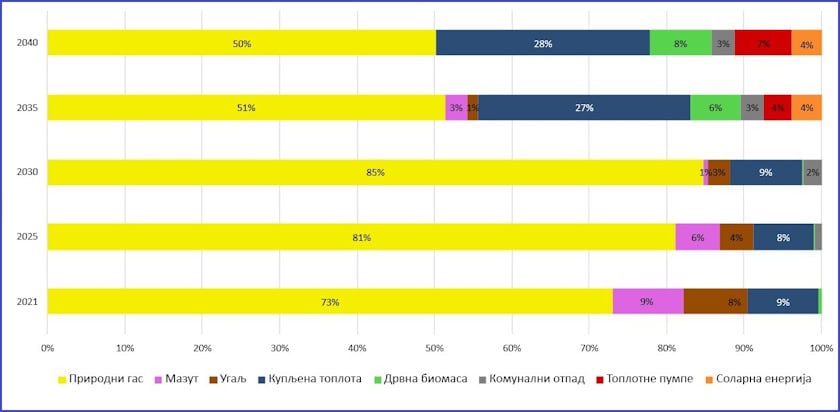
Projected Energy Mix for 2040
In response to questions about the impact of decarbonization on the operation of district heating plants and on citizens, the Ministry states that residents will benefit from cleaner air in urban areas, especially where coal and heavy fuel oil are currently in use.
Strategic Plan for Decarbonization Policy in the District Heating Sector Under Development
“It is crucial that, in parallel with the transition from fossil fuels to renewable energy sources, comprehensive energy renovation of buildings is carried out to reduce the amount of energy required for heating. This will also significantly improve residential comfort,” Vukadinović noted.
She added that decarbonization must also lead to improvements in the overall performance of district heating companies, including reducing network losses, modernizing substations, and introducing both daily and seasonal heat storage systems. Financially, the operation of district heating companies should become less dependent on the volatility of imported fuel prices, Vukadinović emphasized.
A Strategic Plan for the Decarbonization Policy of the District Heating Sector is also being prepared, in cooperation with the European Bank for Reconstruction and Development (EBRD) and the District Heating Companies Association of Serbia.
The document will outline the steps needed to enhance district heating systems, including heat storage solutions, the deployment of heat pumps, the utilization of waste-to-energy heat, and the development of the first district cooling systems.
Source: Balkan Green Energy News